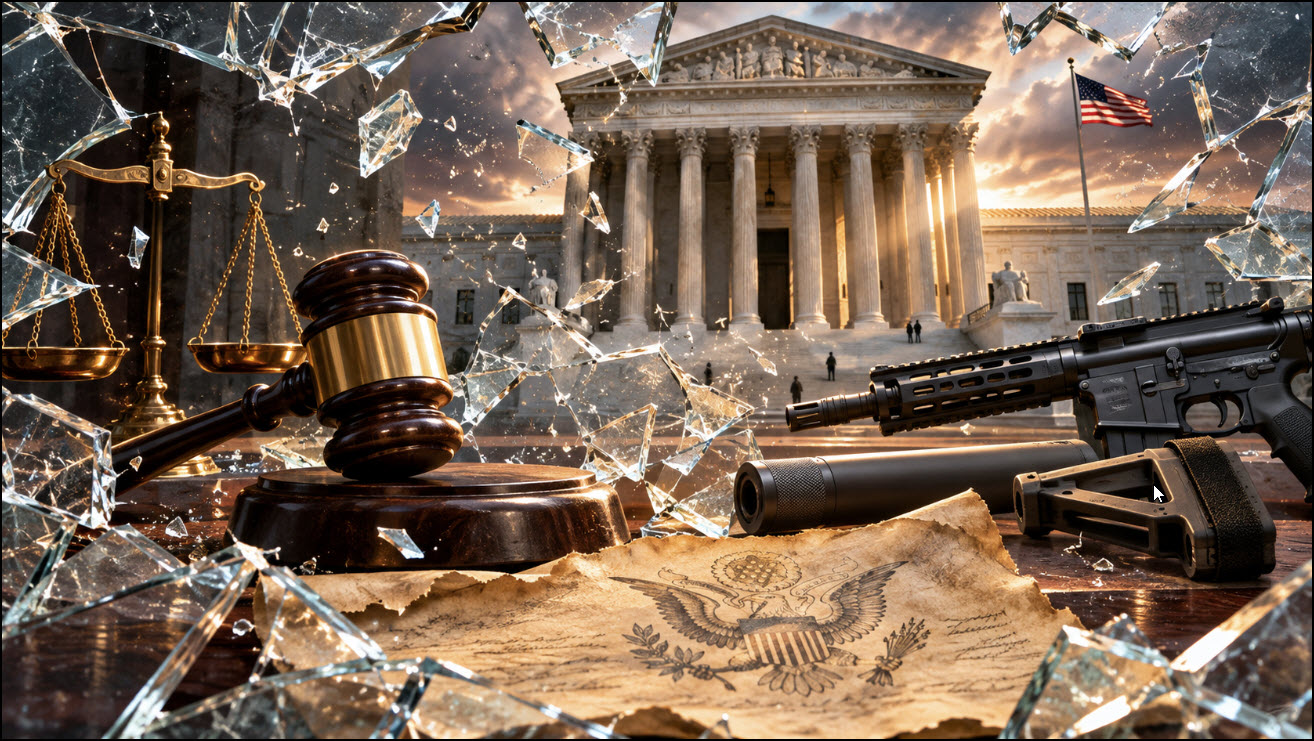
There are very few sure-things in life other than death and taxes. If you heave a concrete block at a plate-glass window there is one thing for certain: there will be a lot of broken glass. IANAL (I Am Not A Lawyer) but another certainty is judicial action that eliminates 92 years of bad precedent involving the 2nd Amendment (2A) is akin to hurling multiple concrete blocks at several plate-glass windows… with a catapult.
A recent Federal Court decision out of the Northern District of Texas (Silencer Shop Foundation v. ATF, which was combined with Jensen v. ATF) broke a lot of glass concerning the National Firearms Act of 1934 (NFA of 34.) Passed in the wake of prohibition-era gangsters and their violent reign across the country, NFA of 34 added a $200 tax to machine guns, short barreled rifles (SBRs,) short barreled shotguns (SBSs,) and suppressors (referred to as “Silencers” since the original name “Firearm Mufflers” didn’t work well with marketing of these items.) In order to make sure the tax was collected; a registration scheme was included. In 1934 $200 effectively doubled the price of a Thompson sub-machine gun (better known to history as the Tommy Gun.)
Former Supreme Court Justice Robert Jackson is credited with a quote along the lines of, “Laws created during times of crisis are rarely undone once the crisis has passed.” Justice Jackson joined the Supreme Court Of The United States (SCOTUS) in 1941, seven years after the NFA of 34 became law. The crisis that led to the NFA of 34 was the prohibition-era gangsters like Bonnie Parker and Clyde Barrow. Laws didn’t stop Bonnie and Clyde, John Dillinger, or Pretty Boy Floyd. They were stopped by men with guns.
Coincidentally Justice Jackson took over as an Associate SCOTUS Justice when Justice Harlan Stone became Chief Justice. Justice Stone wrote the majority opinion in the first case that upheld the NFA of 34: Sonzinsky v. US 1937. The NFA of 34 was upheld because it is a tax law. Congress has the authority to tax under Article 1 of the US Constitution. Justice Stone wrote in the opinion, “(SCOTUS) will not undertake by collateral inquiry as to the measure of the regulatory effect of a tax, to ascribe to Congress an attempt, under the guise of taxation, another power denied by the Federal Constitution.” In the following paragraph he wrote, “We are not free to speculate as to the motives which moved Congress to impose it, or as to the extent to which it may operate to restrict the activities taxed.” Putting that into my IANAL speak, Justice Stone was saying, “We know Congress is doing some Constitutionally shady stuff under the authority to tax, but it’s not in our lane to investigate.”
Fast-forward to 2025 and “The One Big Beautiful Bill” (also known as the Budget Bill for 2026.) Among other things, the tax on short barreled rifles (SBRs,) short barreled shotguns (SBSs,) and suppressors went from $200 to $0. Many of us watching from the 2A advocacy cheap seats were saying this would remove SBRs, SBSs, and suppressors from the NFA of 34 and end the registration requirements for these items. This article from July 2025 covers the one big beautiful bill. When it became 2026, every 2A advocacy group you ever heard of (and some you haven’t) filed lawsuits in multiple US Circuit Court jurisdictions. Divide and conquer was the strategy.
5 August 2026 in the US Federal Court of Northern Texas: Federal Judge James Wesley Hendrix ruled that (paraphrasing here) no tax means SBRs, SBSs, and suppressors are no longer under the requirement for registration in accordance with the NFA of 34.
On 9 October 2026, the almost unthinkable happened. The ATF and the Department of Justice (DoJ) not only hadn’t appealed Judge Hendrix’s ruling, but the ATF published a list of frequently asked questions (FAQs) concerning not only the plaintiffs (named parties in the Silencer Shop/Jensen cases,) but “enforcement discretion” that affects all lawful gun owners. This includes suppressors/SBRs/SBSs and All Other Weapons (AOWs) which include smoothbore pistols, pistol-grip shotguns less than 26 inches overall length.
Again IANAL, so nothing I say, write, or communicate by ANY means should be taken as legal advice. The ATF FAQs are at https://www.atf.gov/firearms/update-to-nfa-transfer-guidance. Take a look, ask questions, get advice.
A lot of caveats here to say the least. Are you a Federal Firearms Licensee (FFL?) You still are paying the special occupational tax and have other restrictions still in place. Planning to cross a State line with an SBR or SBS? Gun Control Act of 1968 (GCA of 68) requirements to file an ATF Form 20 are still in place.
Are you planning to acquire a suppressor/SBR/SBS/AOW by ATF Form 4473 and not register it under the NFA of 34? I recommend (have I mentioned IANAL?) checking as many boxes in the Silencer Shop/Jensen cases as possible. ATF “enforcement discretion” is one thing, being a plaintiff in a member organization(s) and a customer of a named plaintiff checks many boxes, including being covered under an injunction of a US District Court.
Who are the plaintiffs? In Silencer Shop Foundation case it’s: Silencer Shop Foundation, B&T USA LLC, Gun Owners of America (GOA,) Firearms Regulatory Accountability Coalition, Gun Owners Foundation, Palmetto State Armory, SilencerCo Weapons Research, and one named individual.
Plaintiffs in the Jensen case? Named individuals (including one named Jensen,) Hot Shot Customs LLC, Texas State Rifle Association, Firearms Policy Coalition Action Foundation, and the Citizens Committee for the Right to Keep and Bear Arms (CCRKBA.) Future members of the membership organizations in both cases are considered plaintiffs.
The Texas State Rifle Association (TSRA) is the State affiliate to the NRA (like ISRPA is in Indiana.) Are NRA members considered plaintiffs? Sadly, no. TSRA has separate membership, like ISRPA. TSRA is a plaintiff because the NRA is a plaintiff in Brown v. ATF filed in Missouri, which is a different US Circuit. (Part of the divide and conquer strategy.) Likewise, the CCRKBA is the advocacy affiliate of the Second Amendment Foundation (SAF.) Are you a SAF member? Maybe you joined the SAF to lawfully carry a firearm in a Post Office under Firearms Policy Coalition et al v. Garland/Bondi/Blanche (like I did?) CCRKBA has separate membership, so SAF membership doesn’t count. Lifetime CCRKBA membership is $150… just saying.
Where else is glass being broken in support of the 2A? Viramontes (it might be Khaya as the lead plaintiff by the time you read this) v. Cook County, Illinois (challenges Cook County, Illinois’ “assault weapon” ban and was combined with Grant v. Higgins out of Connecticut) has oral arguments in SCOTUS scheduled on 2 December 2026 at 10:00 AM. This is the case the ISRPA is a named party in an Amicus Curiae (Latin for “Friend of the Court”) Brief (more commonly called an Amicus Brief.) This case has had Amicus Briefs filed by everyone from the NRA to the Crime Prevention Research Center (Dr John Lott) to Assistant Attorney General Harmeet Dhillon. I coined the phrase “Amicus Brief Dogpile” after reading so many pro-2A briefs in support of Viramontes.
More broken glass? In the case Cheeseman v. Attorney General of New Jersey, the 3rd US Circuit ruled that New Jersey’s “assault weapons” ban and magazine capacity limits were unconstitutional.
Again, the broken glass is metaphorical, but the chaos is real. As gun owners and 2A supporters we are witnessing significant changes the likes of which no one has ever seen in the history of our great country. I say, embrace the chaos! Great things are happening and we are part of it.
About the Author