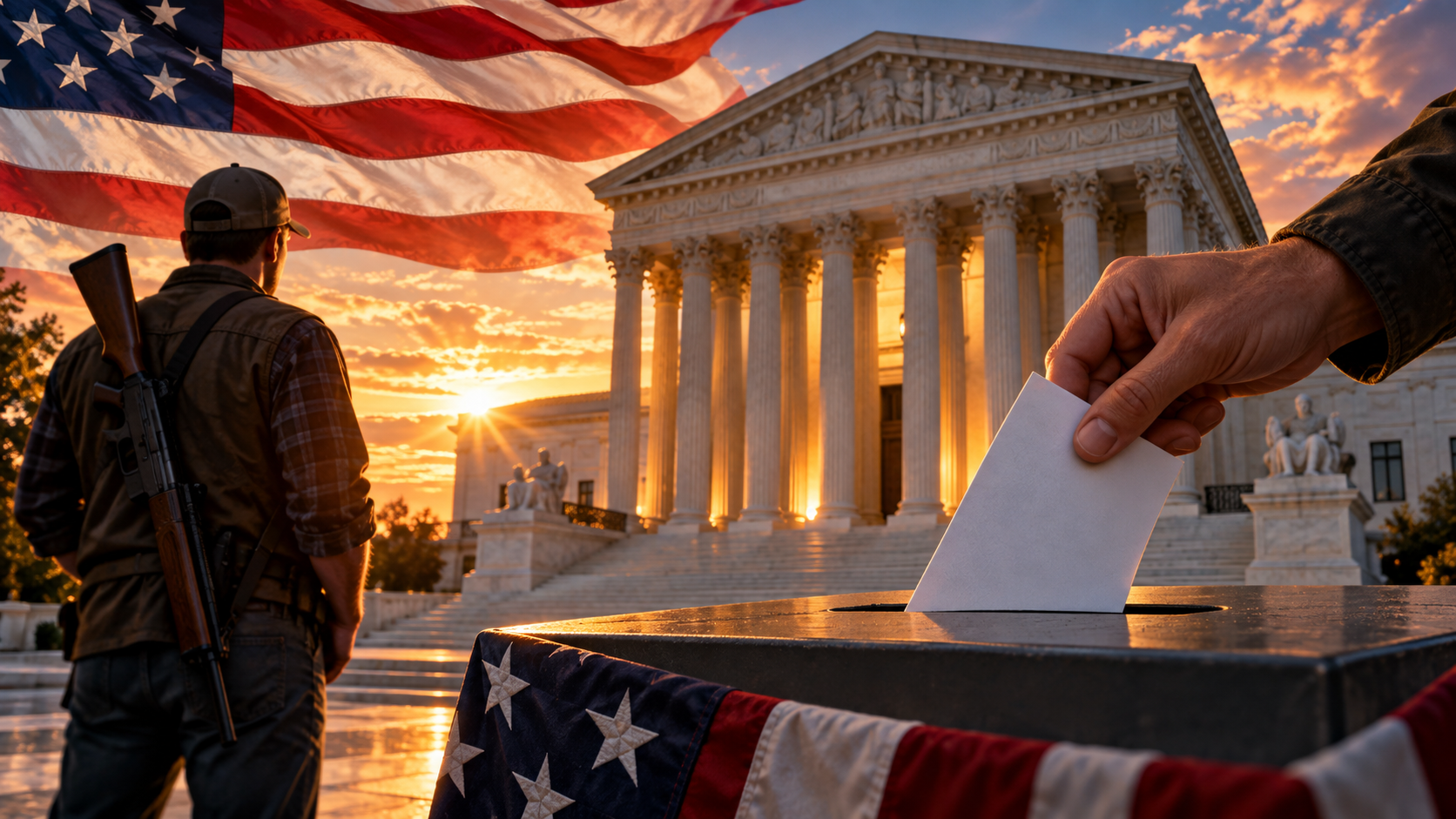
(Even Mid-Term) Elections have ConsequencesThe latest Supreme Court Of The United States (SCOTUS) session gave 2nd Amendment (2A) supporters a reason to celebrate: not one but two pro-2A rulings with US v. Hemani and Wolford v. Lopez. In the next SCOTUS session two cases involving “assault weapons bans” and magazine capacity limits will be heard.
Getting out and voting in ALL elections is how we keep our advantage in SCOTUS and how we keep putting things in the 2A win column. During the last mid-term general election in 2022, 40% of Hoosiers registered to vote actually voted. With that math and our current tally of registered voters here in Indiana, a 40% turnout would mean over 2.89 million Hoosiers who are registered to vote, won’t vote. Gun owners not voting is a huge problem. As a very politically active friend of mine remarked in 2024, “If half the deer hunters in Pennsylvania showed up to vote, Pennsylvania wouldn’t be a swing-State.”
How close were we to losing the 2A as we know it? I would say very close, especially when viewed from the aspect of “even mid-term elections have consequences.” DC v. Heller (2008) held that the Right to Keep and Bear Arms is a pre-existing individual right. McDonald v. Chicago (2010) held that the 2A applies to States as does the 1st, 4th, 5th, 6th, and 8th Amendments. Both of these landmark SCOTUS cases were 5-4 decisions.
On 12 February 2016, the SCOTUS Justices included: Chief Justice Roberts, Justices Scalia, Kennedy, Thomas, and Alito. These Justices were the 5 in the 5-4 Heller and McDonald decisions. The other four were Justices Bader-Ginsberg, Breyer, Sotomayor, and Kagan. Two of the four dissenting votes in Heller, and three of the four dissenting votes in McDonald.
On 13 February 2016 we lost Justice Antonin Scalia, who wrote the majority opinion in DC v. Heller. SCOTUS was effectively 4-4 on the 2A at this point. President Obama nominated none other than Merrick Garland to replace Justice Scalia. You probably remember Merrick Garland as Joe Biden’s Attorney General who called parents who spoke against school policies at school board meetings “domestic terrorists.” The Senate Majority Leader in 2016 was Mitch McConnell, not Harry Reid. If Harry Reid had been Majority Leader Merrick Garland would’ve been a SCOTUS Justice replacing Antonin Scalia in 2016, not Neil Gorsuch in 2017. For 2A supporters, SCOTUS would be 4-5.
Since this article is about mid-term elections, I won’t go into who Hillary Clinton would’ve nominated for SCOTUS if she’d have become President instead of Donald Trump. Neil Gorsuch would’ve replaced Justice Kennedy in 2018 opposed to being replaced by Justice Kavanaugh. SCOTUS would still be 4-5 in terms of the 2A, opposed to the more solid Pro-2A 5-4 we had in 2018.
In 2020 the notoriously anti-2A Justice Ruth Bader-Ginsberg died. If Chuck Schumer had been Senate Majority Leader instead of Mitch McConnell, President Trump’s SCOTUS nomination of Amy Coney-Barrett would not have gone to the Judiciary Committee and not moved forward for a Senate vote. Ketanji Brown-Jackson would’ve replaced Justice Bader-Ginsberg instead of replacing Justice Breyer.
Justice Breyer no doubt would’ve been pushed towards retirement as he was anyway. If you remember back in 2022, Justice Breyer was quite surprised to hear of his upcoming retirement. Despite being a Bill Clinton appointee who opposed the three biggest Pro-2A SCOTUS cases in history (Heller 2008, McDonald 2010, and New York State Rifle and Pistol Association (NYSRPA) v. Bruen (2022) Justice Breyer was 84 years old. We would probably have Sri Srinivasan from the DC Circuit who was on Obama’s short list to replace Justice Scalia and was on Biden’s short list for SCOTUS.
Make no mistake, if this scenario had played out, there would have not been the landmark NYSRPA v. Bruen (2022) decision. Bruen gave us the “text, history, and tradition” standard concerning laws involving restricting 2A Rights opposed to the (so-called) “balancing test” where Judges (like Sri Srinivasan) decided how much 2A infringement was OK in the name of “public safety.” As Justice Thomas wrote in the Bruen majority opinion, “the 2nd Amendment is not a second-class Right.” Would a “balancing test for public safety” be acceptable for infringement of free speech or a 1st Amendment violation? If you must quarter only three soldiers in your home without your consent, is that acceptable under the 3rd Amendment? Warrantless searches, involuntary self-incrimination, and not allowing legal counsel representation would do wonders for “public safety.” These would also violate the 4th, 5th, and 6th Amendments.
On the subject of “public safety” a landmark SCOTUS case from 60 years ago comes to mind: Miranda v. Arizona (1966.) This case led to the requirement to read the “Miranda Rights” (You have the right to remain silent. Anything you say can and will be used against you in a court of law…) to suspects in custody and being interrogated. The lawyers for the State of Arizona and the Solicitor General of the United States argued that informing suspects of their Constitutional Rights would endanger public safety. I wish I was kidding but I’m not. Far from unanimous, Miranda (1966) was effectively a 5-3 SCOTUS decision since one Justice both concurred and dissented.
With a 4-5 SCOTUS and no landmark Bruen (2022) decision, what other 2A wins would be in the loss column? Age restrictions (18-20 year olds) would still be in place in many States. The “assault weapons ban” and magazine capacity limits cases at SCOTUS in the next session wouldn’t be there. Numerous cases involving being disarmed for life due to non-violent felonies wouldn’t have seen the light of day. Wolford v. Lopez (2026) which was reviewed at length last month, applied “relevantly similar” to Bruen’s text, history, and tradition standard… would not have happened. “Relevantly similar” is from US v. Rahimi (2024) which wouldn’t have gone to SCOTUS since the 5th US Circuit cited Bruen (2022) as a 2A violation in their judgement. The challenges to the US Postal Service rule against carrying firearms on Postal Service property (Bonidy v. US Postal Service) which are currently ending this infringement on 2A Rights? Would not be happening.
The other Pro-2A SCOTUS case from this session was Hemani v. US (2026.) While Hemani was a rare unanimous decision, would SCOTUS have accepted the case if not for Bruen?
Another SCOTUS case that wasn’t 2A-related but did greatly impact gun owners was Loper-Bright Enterprises v. Raimondo (2024.) This case ended “Chevron deference” which was a 40-year-old bad precedent which required the Judicial Branch to defer to “Executive Branch experts.” This allowed Executive Branch agencies to publish rules outside of specific legislation, that had force of law. Remember when the ATF published 500 pages of rules covering “engaged in the business of selling firearms” but couldn’t define the rules? Loper-Bright (2024) was vitally important to gun owners.
Loper-Bright Enterprises v. Raimondo (2024) was a 6-3 decision. I am certain that a SCOTUS 4-5 on 2A would’ve let Chevron deference stand. Executive Branch entities would still be publishing rules (with force of law) that had no legislation directing the action.
Team 2A has been putting up some impressive wins over the past few years. There is a phrase from the 1970’s that comes to mind here, “Keep the pedal to the metal.” Putting things in the win column for lawful gun owners starts with getting to the polls, and encouraging other gun owners to do the same. Do you know a deer hunter? Ask them if they are voting.
About the Author