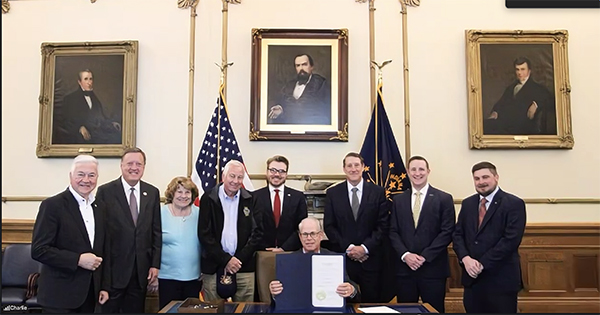
On 21 May 2026 at 2:55pm, the Clerk of Indiana Supreme Court filed an order signed by Chief Justice Loretta Rush. This order was a paragraph long and simply stated the Indiana Supreme Court would not take a case that had been unanimously ruled on by the Indiana Court of Appeals. While there wasn’t much fanfare, this order effectively ended the near-27-year-old civil lawsuit actually named City of Gary v. Smith and Wesson Corporation, et al, but it is more commonly referred to as “Gary v. Glock.”
I’ll begin with the acronym IANAL (I Am Not A Lawyer.) I definitely don’t know the entire history of this civil lawsuit (late 2023 is when I first got involved, shortly after taking on my role at ISRPA.) My non-legalese take is that Gary sued every manufacturer of firearms because they have a serious crime problem. In addition to firearms manufacturers, the City of Gary also sued local retailers (Federal Firearms Licensees, FFLs.) FFLs have insurance, insurance companies will often settle vice going to court because it is actually cheaper. The manufacturers sell to distributers, who sell to retailers, who sell to individuals. I (I as in IANAL) would hazard a guess to say the thought process was: the manufacturers have deep pockets and will settle as will the insurance companies. The City of Gary certainly couldn’t sue the Bureau of Alcohol, Tobacco, Firearms, and Explosives (commonly called the ATF) for allowing the crime to happen, they have a lot of government lawyers on staff. Additionally, there are immunity statutes involving federal entities making those lawsuits less of a sure thing.
In 2005, the Protection of Lawful Commerce in Arms Act (PLCAA) was signed into law by President George W. Bush. This law prevents lawsuits against the lawful actions of firearms manufacturers (which is manufacturing firearms) for the actions of third-parties committing crimes with firearms. This bill does not make it so you can’t sue over defective manufacturing. Also, if Ford Motor Company was being sued out of existence because people get DUIs in F-150s? You can bet there would be a PLCAMA (Protection of Lawful Commerce in Auto Manufacturing Act.)
In 2005 there were 40 lawsuits against firearms manufacturers. By 2006, 39 of the 40 had been dropped. The one that wasn’t was a civil suit filed in Indiana, Gary v. Glock.
Over the years the Indiana Legislature made significant strides to prevent future Gary v. Glock-like lawsuits. Indiana’s immunity statute from 2001, amended in 2004 stopped filing lawsuits under the nuisance statute. HB 1296 in 2015 created retroactivity to any lawsuit prior to 2015. This led to more attempts to end Gary v. Glock in 2016. By the title of the article, you can tell the lawsuit known as Gary v. Glock didn’t end in 2016.
Fast-forward to late-2023. 400,000 ATF Form 4473s were going to be turned over. This of course is the ATF Form 4473 that contains: full name, address, place of birth, date of birth, demographics, and quite often social security number. This gained a lot of attention among 2nd Amendment (2A) supporters nation-wide. Fortunately, the 2024 session of the Indiana General Assembly was beginning in January.
January 2024: Representative Chris Jeter introduced House Bill (HB) 1235 Prohibited Causes of Action Concerning Firearms. There was no doubt this bill was written to end the lawsuit known as Gary v. Glock and prevent the disclosure of the information on 400,000 ATF Form 4473s.
Later in January 2024 HB 1235 came up for a hearing in the House Judiciary Committee. I remember that hearing well because that was the first time I represented the ISRPA at the Statehouse. It was also the first time I met future Co-Director of Government Affairs Jerry Torr, who was one of the co-authors of this bill. The Pro-2nd Amendment (2A) team represented the NRA, National Shooting Sports Foundation (NSSF,) The 2A Project (T2AP,) as well as the ISRPA. HB 1235 cleared all hurdles and came over to the Senate.
In February 2024 HB 1235 came up for a hearing in the Senate Corrections and Criminal Law Committee. The same Pro-2A Team (NRA, NSSF, T2AP, ISRPA) from the hearing in the House was joined by Constitutional Attorney Jim Bopp. Again, the bill passed out of committee and passed out of the Senate. Since this bill was an emergency action, it would become law when signed by the Governor, opposed to 1 July. On 15 March 2024, this became Public Law (PL) 170. Gary v. Glock was defeated, 400,000 ATF Form 4473s would remain secure. There was much rejoicing.
NOT SO FAST!! In August 2024 a Judge in Lake County denied the motion to dismiss the case. Again IANAL, but it seems the Judge didn’t like the new law.
In December 2025 (16 months later) arguments are made at the Indiana Court of Appeals. Later that month, the Indiana Court of Appeals unanimously ruled the case would be sent back to the district court for dismissal.
In March 2026 (2 years after HB 1235 became PL 170,) The City of Gary (actually Brady United since that’s the entity behind the lawsuit for years) requested petition for transfer to the Indiana Supreme Court. On 21 May 2026 (2 years, 2 months, and 6 days after HB 1235 became PL 170; nearly 27 years since the Gary v. Glock lawsuit was filed in August 1999) Indiana Supreme Court Chief Justice Loretta Rush signed the order denying transfer and effectively ending Gary v. Glock.
When you are on the Pro-2A side of political issues, being in for the long haul is part of it. Nearly 27 years is a very long haul. Nearly every year at the Indiana Statehouse the Pro-2A side moves at least one solid bill forward. Every year there will be a bill or bills that don’t make it up for a committee hearing. We say, “We’ll get‘em next year” and we keep moving forward. There is no other option.
Kelly Myers
About the Author