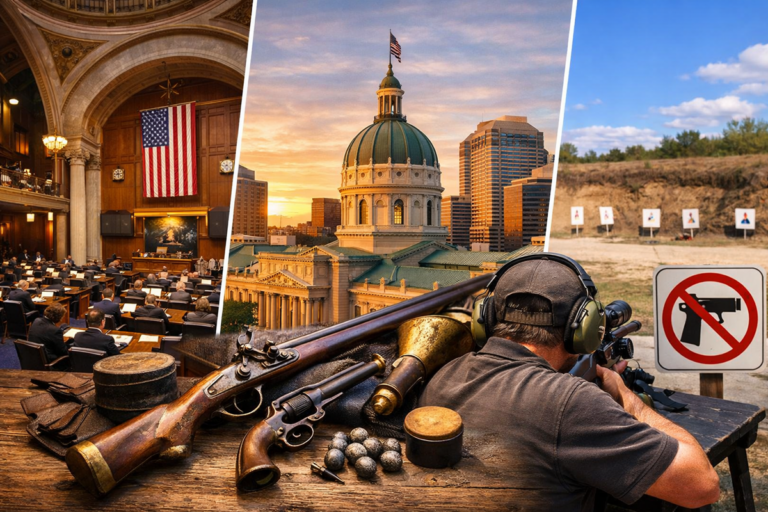
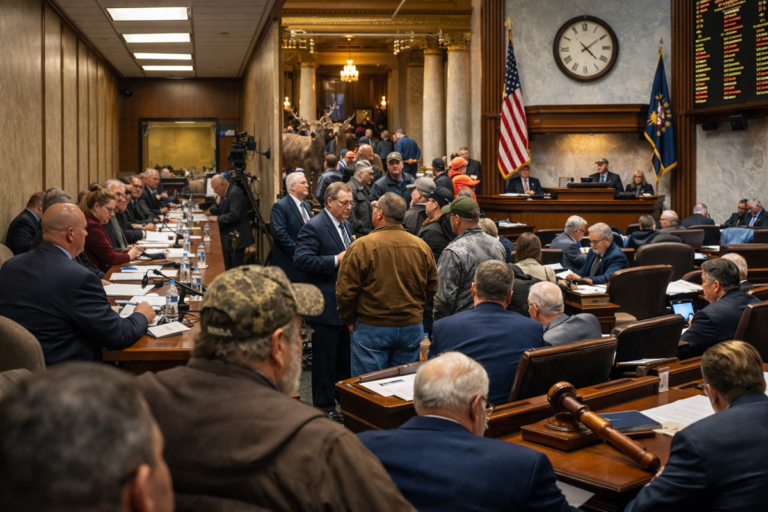
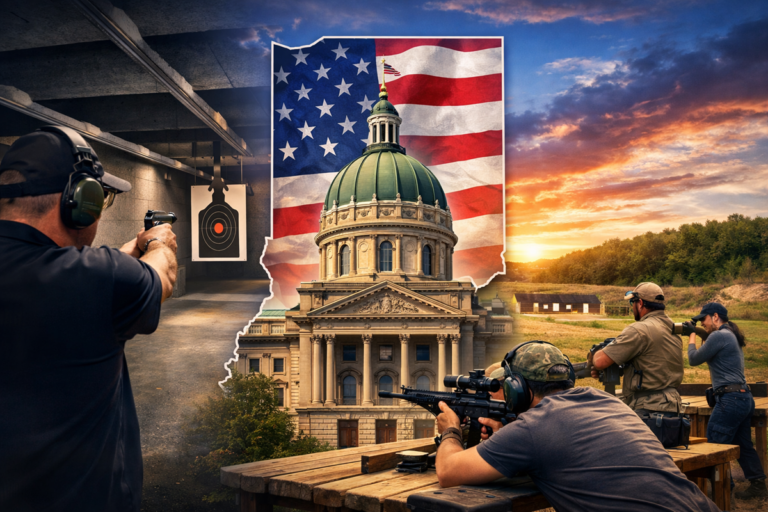
The Fiscal Year 2026 budget bill (better known as, One Big Beautiful Bill) was signed into law by President Trump on Independence Day. While there is a lot in that bill for those who follow politics closely to argue about (and they have, a lot) there is a small part that will have a big impact for gun owners.
The very small part of the Big Beautiful Bill that affects gun owners: The cost of a federal tax stamp (from the National Firearms Act of 1934/NFA 34) required to manufacture or transfer a short-barreled rifle (SBR,) short-barreled shotgun (SBS,) or suppressor (also known as a silencer) decreased from $200 to $0. This change will have a much greater impact for gun owners than just the financial impact.
I’ll start with an acronym: IANAL (I Am Not A Lawyer.) I mention this because to discuss the impact of $0 tax on a tax stamp for an SBR/SBS/suppressor, the law and Supreme Court Of The United States (SCOTUS) cases and precedents must also be discussed.
Full disclosure: I own no SBRs/SBSs/suppressors. I also own no braced (AR/AK) pistols that were recently in a legal fight. I supported braced (AR/AK) pistols because while I own none, I do own the guns the anti-2nd Amendment (2A) usual suspects also want to ban. With that said, let’s take a look at how we got where we are, and how far away it is from the words of the Founders who wrote the 2A, and the early Hoosiers who wrote the Indiana Constitution.
“A well regulated Militia, being necessary to the security of a free State, the right of the people to keep and bear arms shall not be infringed.” “The people shall have a right to bear arms, for the defense of themselves and the State.” That is of course the 2A of the US Constitution, and Article 1 Section 32 of the Indiana Constitution. Fast forward 231 years from the Bills of Rights to the landmark New York State Rifle and Pistol Association v. Bruen 2022. Bruen gave us the “text, history and tradition” standard as far as regulating the Right to keep and bear arms. In the majority opinion of the Bruen decision Justice Clarence Thomas wrote, “The 2nd Amendment is not a second-class right.” That is where we started, and where we are now. It is important to look at how we arrived at the place where paying an additional $200 to make our firearms 30 decibels quieter, is the law of the land.
The Summer of 1934 is when the NFA 34 became law. The $200 tax stamp required to purchase a “machine gun” effectively doubled the price of the Thompson Model 1927 (AKA, the Tommy Gun.) The Thompson was a favorite of Prohibition-era gangsters. During the Great Depression very few would’ve had the disposable income to purchase a Thompson, let alone for double the price. Price wasn’t an issue for Prohibition-era gangsters who quite often stole their weapons. When Bonnie Parker and Clyde Barrow met their demise on a dirt road in Louisiana shortly before the NFA 34 became law, they had three Browning Automatic Rifles (BARs) and two short-barreled shotguns (along with a large number of handguns) in the car. The NFA 34 would not have stopped Bonnie and Clyde from obtaining those weapons, laws keep honest people honest.
The NFA 34 is how we ended up with SBS/SBS and suppressors requiring registration and a $200 tax stamp. The registration scheme has been held as Constitutional because it is a means to collect tax. The tax is why there is a registration.
A lot of what will be ammunition (pun intended) that will be used in the upcoming court cases challenging the registration of SBRs/SBSs/suppressors will be coming from SCOTUS cases nearly 100 years old. This is logical since the NFA 34 has been the law of the land for nearly 100 years.
A significant SCOTUS case on this subject is Sonzinsky v. US 1937. Sonzinsky was not a 2A case, it was a tax case. The long and short of this is: a Federal Firearms Licensee (FFL) has to pay the annual license fee to sell weapons subject to NFA 34. The words “tax”, “taxes”, and “taxation” appear 63 times in the SCOTUS decision. This is because the Legislative Branch has the Constitutional authority to “tax”. Taxation of course is a means to raise revenue. In the majority opinion Justice Harlan Stone also wrote, “Courts may not inquire into the motives of Congress in exercising its powers; they will not undertake, by collateral inquiry as to the measure of the regulatory effect of a tax, to ascribe to Congress an attempt, under the guise of taxation, to exercise another power denied by the Federal Constitution.” I think this translates to, “We know they are doing Constitutionally shady stuff, but this is not our lane.”
The most consequential SCOTUS case in this matter is US v. Miller 1939. The Miller case was a 2A case, and it would be another 69 years before SCOTUS would take another 2A case (DC v Heller 2008.) The Miller case upheld the Constitutionality of NFA 34, but only the government presented evidence. Miller wasn’t there (he was in hiding, and for good reason. Jack Miller was murdered in April 1934) and his lawyers weren’t being paid so they didn’t show up.
From the Miller decision: “The Court cannot take judicial notice that a shotgun having a barrel less than 18 inches long has today any reasonable relation to the preservation or efficiency of a well regulated militia, and therefore cannot say that the Second Amendment guarantees to the citizen the right to keep and bear such a weapon.” Would WW I Veterans who were in the trenches of France and Belgium in 1917-1918 have had a significantly different view on this? Does this align with text, history, and tradition?
There are very few if any of you reading this who were alive when the NFA 34 passed into law. While this has been the law of the land for all of our lifetimes, the text, history, and tradition standard established in the Bruen decision in 2022 looks much further back in history. The Bill of Rights was signed into law in 1791 when the Kentucky Long Rifle was superior to the Brown Bess muskets used by the British in the war we had just fought. The Bruen decision also looks back to the time the 14th Amendment was passed in 1868. In 1868 lever-action Henry and Winchester rifles were common, and the US Military wouldn’t have a rifle that wasn’t a single-shot until 1892.
For the majority of our great nation’s history, the “bearable arms” (those protected by the 2A) were superior to those of the Military. Within the next year we (lawful gun owners) have the opportunity to gain back something we lost in 1934. The NFA 34 did nothing to stop the Prohibition-era gangsters, who were stopped only with violence of action. That is because laws only affect the law-abiding.
About the Author